Thursday, 9 October 2014

Learning from Objects– Rachel McLaughlin


Recently we had a training day at the Oxford University Museum of Natural History and Pitt Rivers Museum. The sessions were about learning from objects. About 15 people attended from museums all over the South East. We had a wide variety of objects to learn with, from pennies and amulets to textiles and trees. 

We started with some coin handling. Coins are very interesting for many museum visitors as everyone already knows what they’re for. Museum staff  are often asked “what is it worth?” Learning to read the symbolism and exploring what a coin can tell you about a certain place and time can give a great starting point to begin learning about the people who used the coins.

The second session was all about drawing from objects. In pairs, one person had the object, and had to describe it to their partner who hadn’t seen it – and they had to draw it. We had some very interesting attempts! We then tried other methods: with our non-dominant hand,  without looking at our paper, by using one continuous line and from memory. Drawing something so many times and in such a variety of way really helped us lose our fear of drawing badly and it really made observational drawings fun!

My drawings


We had two sessions in the Pitt Rivers – one was a way to explore the museum by taking objects and an associated map locating similar items. We had to find out where the objects were from, and what they were used for. It was exciting to be able to explore the museum for ourselves and reporting back gave us the ownership of the information we had found. We also had the last session of the day there, doing a couple of quizzes about what objects can tell us about the people who owned, used or made them. 
 
Trees are also objects! Leaves, bark and flowers can also all be used as objects in sessions. Lynn Daley from Harcourt Arboretum got us categorising leaves to create a key, and brought in her imaginary giant redwood which she takes out into schools. We all stood inside its trunk, and discovered how big it is compared to the lawn in front of the museum of natural history.
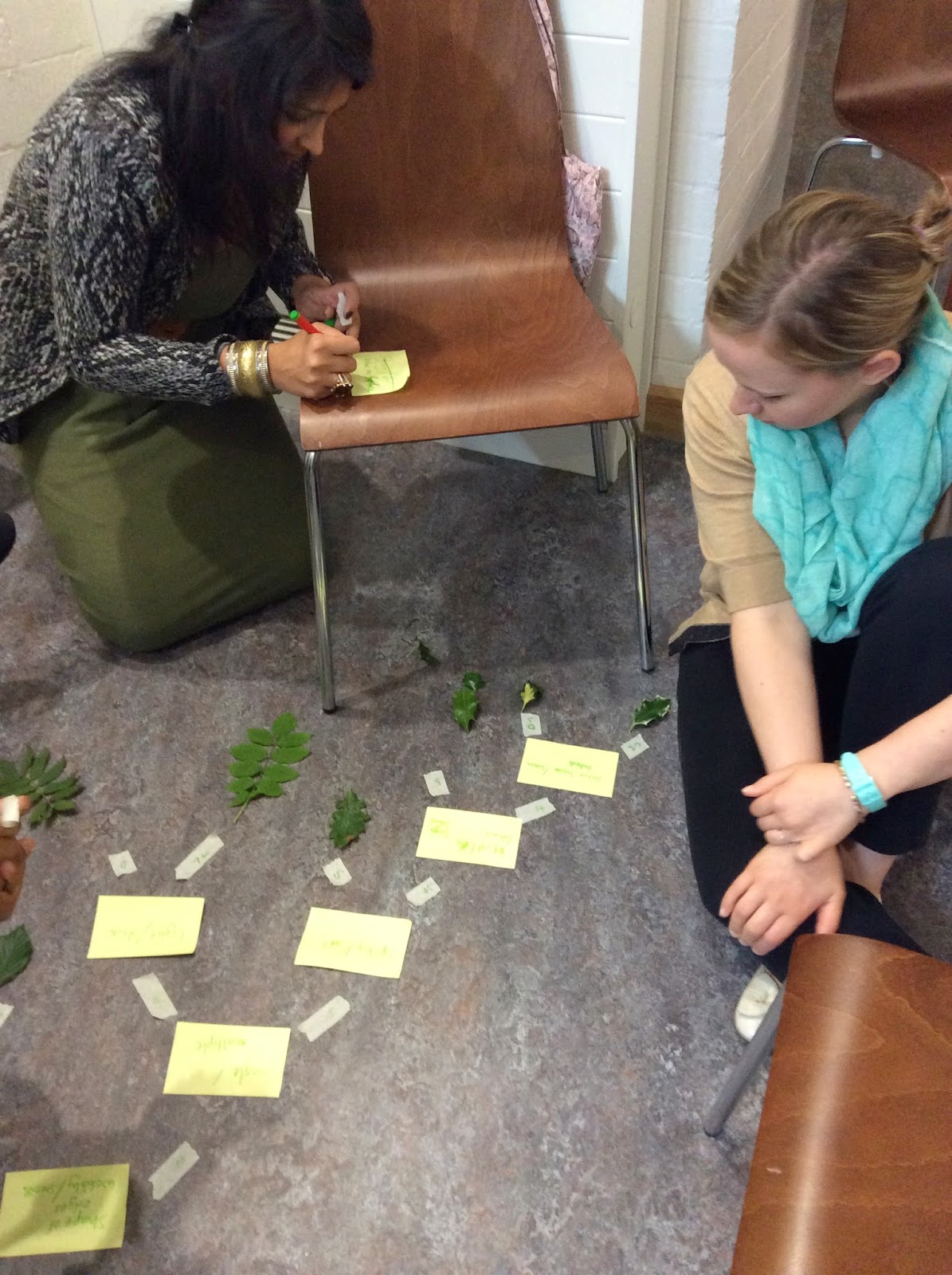
Trainee Corie and other group member creating a leaf key


One of the community outreach officers, Nicola Bird, brought in a variety of objects made of fabric, and some fibres and materials which go with them. The activity made us really feel the fibres carefully, and we were encouraged to think about the objects more generally as we interacted with them. Were things heavier than we expected? Were they softer than we expected? Talking to each other about the objects was enjoyable as well as helping us learn something, and having fun is one of the main aims of outreach sessions.

Emma Williams from the Botanic Garden brought a variety of seeds for us to categorise, we had to think hard about how some seeds would disperse themselves. Finding the seeds which disperse by propulsion (i.e. exploding) was very exciting – we probably dispersed a few too many seeds around the inside of the museum annexe!

Objects and activities from Harcourt Arboretum and the Botanic Garden

Throughout the day, many similar techniques were used to extract information and use the objects educationally. We always had to look carefully – questioning techniques and activities always encouraged considered observation. We were encouraged to find out about objects non-judgementally, to find common themes between them and identify aspects that were either familiar or new to us. The wonder and fascination which interacting with an unfamiliar object is a big part of museum education – the excitement that is then associated with exploring museum objects can really change attitudes to learning new things.

Tuesday, 7 October 2014

Feeling better: Museum Objects and Well-Being – Mary Cook


In my hand I hold a black and white picture of some little children in uniform drinking their school milk.  The girls have short bobbed hair and are smiling – the image goes back before my time but it has an instantaneous association.  I remember  my first day at school wearing the blue jumper with rabbits on the pocket that my mum knitted.  I remember the red shoes and the pencil case with Holly Hobby on it.  I remember the cool taste of the milk, the condensation on the glass bottle and the unbending straw which was uncomfortable if pushed up in the mouth. 

I remember my peg where we changed our shoes and coats and the carpeted steps where we listened to the radio show “listen with mother” while trying hard not to fall asleep.
The little girls in the photograph provoke a memory too – my mother in a photograph with just that hairstyle.  And that little girl looks a lot like a younger version of my niece. 

It caught me out that wave of memory and association from a photograph in the museum. 
And I was not alone in experiencing unexpected positive association; it became clear as the other trainees shared the objects they selected.   Despite the fact we were technically “too young” for the activity, these objects took us back in our own timelines and reminiscence. As a group we learned a little bit more about one another.

Trainees during a training session on reminiscence
Helen Fountain had been telling us about her work at the Museum of  Oxford  and out in the community taking objects for handling and reminiscence to groups of older people.  That is to say 120 sessions delivered to 1,500 older people per year!

The theory we nodded along to, it all seemed a very good idea, very educational.  Helen wanted us to see the value in terms of health and wellbeing too. Each person in a group would feel their contribution validated, they would feel less isolated and have fun.  The visitor and the objects would be a welcome break from the routine.  For carers it is an opportunity to learn a little more about the person in their care, assisting with life story and care planning. It’s not just a one way street in terms of benefit either.  The museum would benefit from the generation of oral history resulting from these groups and a wider more inclusive audience. 

It’s not just theory though.  There is a good body of evidence on the benefits of object handling in hospitals and care homes, for example:
                                                                                                                      
“The pilot project ‘Heritage in Hospitals’ demonstrates that handling museum objects can have a positive impact on patient wellbeing as patients, on average, recorded higher scores on visual analogue scales measuring life satisfaction and health status after handling museum objects.”
Museopathy; Exploring the Healing Potential of Handling Museum Objects by Helen Chatterjee et al (2009)

I wondered: how do inanimate objects have a verifiable effect on health and wellbeing?  Is that effect a constant?  Will it occur outside of control conditions, in a self selecting group who have access to the opportunity more sporadically? And what works?  What outside of the museum constitutes a reminiscence object?

I joined Helen for an outreach reminiscence session to find answers to some of these questions.  She had brought objects on the theme of rural life: growing up in the countryside.  Even today Oxford is blessed with meadow and rural locations close at hand, but I did wonder how this theme would play out with a city based group with potentially restricted mobility. 

The memory unlike the physical body is remarkably free to travel in time and space.  Childhood connections with farming and the countryside were shared, prompted by photographs and objects.  These were multiple and varied.  Many  objects and  photographs were included:  a photograph of river swimming near Cowley;  a collection bag from a church; sheep shears, a photograph of a bread trolley being pushed by bakers across ice in Chipping Norton;  horse brasses ,a riding hat and a milk churn.  New tangents occurred too – which helped us see into the life stories of the group in new and surprising ways across wider themes of work and family life.  It also took us further back in time than one might expect too as people shared their parents’ or grandparents’ stories as well as their own.  We crossed the country too – with local stories interspersed by those of people who once lived further afield.

The session drew to a close with a birdsong quiz and old time music signalled it was time for lunch.  Some people danced out of the room – a very clear sign they were happy!  Sound added another dimension to the session which had been a very pleasant experience for all involved.  Smiling, listening and sharing showed the ease they felt with one another and with Helen.


I was aware of research supported by the National Trust into the benefits of birdsong and had been aware of the benefit of being outdoors or having even a view of the outside in promoting recovery.  It makes sense to me that reminiscence by taking you into other environments through memory might have a similar beneficial effect.   What I am wondering now is whether we can layer up some of these benefits.  Perhaps object handling, outdoors using natural soundscapes could even improve on these effects?  It’s something I hope to see on my final placement at Oxford University Botanic Garden next year as I am aware that Helen Fountain’s Memory Lane group have benefited from visiting sites of association as much as they have from sharing objects from them.

Friday, 3 October 2014

A new perspective; the value of working with trainees - Rachel Parle, Interpretation and Education Officer, Museum of Natural History


I remember, back in 2011, shifting furniture around in the already crowded Education office, desperately trying to fit in a desk for our new trainee, who was arriving the next day. As well as concerns about space, I hadn’t been working in the museum for very long myself at this point, so I was unsure of how the dynamics in the team would change with a new arrival. Would I feel like a spare part? Would the trainees look to me for advice on areas where I was still learning? It was definitely a step into the unknown.

Our first trainee turned out to be Scott Billings, who never moaned about his rather squashed work space and spent a very productive six months here at the Oxford University Museum of Natural History. He added energy to the office, created activities that are still in use today and became a good companion in the pub on Friday evenings. 

This was a reassuring start to the HLF Skills for the Future project and I’ve felt a lot less anxious each time a new arrival has joined the team. The variety in experience, backgrounds and expectations of the trainees has kept everything fresh and the way they fit into the team has been different every time. 

Rachel (right) and trainee Liz (centre), Artsweek Festival


I value working with trainees because they offer a new perspective on what we do. When you’re flat out delivering or developing, you often don’t allow yourself time to sit back and think about whether this approach is the best one. You’ve always done this, so why would you change it now? But once you start talking about this with a trainee, you need to justify what you’re doing and why you’re approaching it in that way. This forces you to reflect on your own practice, and offers the opportunity to discuss the trainee’s opinions and suggestions. I’ve often been amazed by suggestions and ideas that are offered. With experience outside Oxford University, and a pair of fresh eyes to look at what we do, trainees help keep us on our toes.

Rachel (2nd left) with trainees (l-r) Aisling, Mary and Rachel


Having a trainee in our office is now completely normal. In fact I find it hard to imagine what my day-to-day working life will be like when the project ends next year. They become an important part of our team during their placement and we do our best to involve them in meetings, decisions and the general running of the Education department.

Funnily enough, we’ve been moving furniture again recently. Scott is back in our office, with a new job title and a new desk. As our Public Engagement Officer, Scott juggles digital projects, social media and communications. It’s safe to say that the Skills for the Future programme will have a legacy well beyond its 4 years, both for the trainees who took part, and for those of us who have had the pleasure to work with them in our teams.

Wednesday, 1 October 2014

Designing a new backpack for children to explore Harcourt Arboretum - Corie Edwards


When I began my placement at Harcourt Arboretum about 4 months ago on my very first day Lynn, the Education Officer on site, gave me a task of thinking of something I could leave behind once my placement was over. Her suggestion was to add 1 or 2 new activities to the backpacks planned for next year. I quite liked the idea of something I designed being used when I was gone and therefore quickly took to this task to see what I could add to the backpacks. After loads of rummaging through boxes of supplies and reading through the backpack cards I came up with a couple activities I could add. However, I didn’t stop there. I kept thinking…

Now, this thinking happened when the Education Officer was away so I had a couple days to get all my thoughts on paper. And my goodness was it a lot of ideas that didn’t really connect yet. When Lynn returned I promptly showed her what I had been doing whilst she was away. It quickly became clear that my ideas were too much to add to a current backpack and the themes didn’t really fit. Therefore, she said if I could find the time between everything else I was doing on this placement I could design a new backpack that would run at the Arboretum next year. I was absolutely delighted and over the four months used any spare time at work to further develop my backpack.

The backpack that I designed is called Junior Arborist and it gives children activities to do with trees that are similar to what the arborists do on site. For instance, the arborists regularly measure the height of trees, but they do this by climbing to the top. We cannot have children trying to climb to the top of trees therefore the backpack describes to them how they can measure a trees height with just themselves and no equipment. 

measuring the height of a tree

 In total there are four activities in the backpack that can be done anywhere in the Arboretum with any trees:

·         Measuring a trees height
·         Collecting parts of a tree (off the ground) to create a piece of artwork on the grass
·         A mirror to look up into the trees and tell the others in the group what you see
·        How to read the Arboretum’s tree and plant labels, then using that diagram to find as many species as you can in 1 turn of the egg timer

 
Natural artwork created from collected pieces of tree


When the children have finished with the backpack they will hopefully know a great deal more about trees and their care. Therefore, when they return the backpack they receive an official Harcourt Arboretum Junior Arborist badge!


I don’t want this task to sound like it was easy. Designing a new backpack for a site I have been at for only a short time took loads of effort. I know the backpack I just described sounds put together, but that came from lots of honing down of ideas and many edited drafts. Just as a frame of reference my first idea was Arrrrr-boretum (pirate themed), then modifying a Dr Seuss rhyme (not possible without copyright permission), then spelling Arboretum with different tree varieties, and then finally creating my own rhyme about trees. II scrapped all of the ideas except my own rhyme.


It was from reading and editing the rhyme over and over that the idea of Junior Arborist came to being. The rhyme is about all the different kinds of trees on site and the arborists are the ones who look after them all, so why not combine them? Which then left the task of designing what the children could do that is similar to arborists. I came up with the activities by consulting with the arborist team to learn more about what their job entails. I also spent time watching them work on trees. Through this teamwork I started to form activities children could do and then would consulate with the team again to see if the activities I designed were true to their job.

Contents of backpack


I learned a great deal from designing a new backpack. Firstly, time management. I only had a small window each week or sometimes fortnightly to dedicate to this project. I had to use that time wisely to get the backpack finished before my placement ended. Secondly, designing a backpack is completely different than anything else I have designed here. Anything I designed for families or schools had structure through a trail or planned activities. With a backpack I had to let go of some of that structure. A backpack is meant for exploring the Arboretum, therefore there couldn’t be a set route or certain trees they should see and the activities had to be suitable for anywhere they ended up, whether that was 800 metres away from where they began or if they sat down under a near by tree for lunch. Lastly, appropriate instructions and activities for the age range that usually borrows backpacks at the Arboretum. I didn’t want each activity to have a long explanation but I still needed the activity to be understandable. Finding that balance came from feedback from Lynn and the arborist team and constant editing.

I feel extremely proud of what I have created and hope that children who use it next year will enjoy using the backpack.

If you would like to come to the Arboretum and use the Junior Arborist backpack it will be available from the ticket office from April to November 2015. They are free to borrow with entry.