Wednesday, 3 September 2014

A Grand Day Out – Camilla the Cockroach with typing assistance provided by Mary Cook


It’s a happy life at the Oxford University Museum of Natural History (OUMNH).  You get to hang out with your many friends, eat as much banana as you like, and nibble on the odd lump of dried cat food to keep your exoskeleton in good condition.  

We also like a good spritz of water to keep us healthy,  well – we are worth it, us Cockroaches! Underrated in the world  generally, here under the care of the Director of Life and his friends our true value is fully appreciated.  So much so that day trips are organised by the outreach Team so we can go and take a close look at some enormous creatures called human beings. 

We like human beings, who leave so much in the world for our wild cousins to feed on. Our antennae are good at detecting whether they are male or female, adult or child and whether they are good or bad at washing their hands.  Known as detritivores because we eat the stuff no one else would we and other arthropods like the scarab beetle keep the whole planet healthy. 

Last week , we went to Barton where we made some lovely new friends. These were the smaller variety of human being for the most part – smiley, occasionally sticky but always very friendly. 

Rachel lifting me out of my box


While out of the tank, taking a walk around the hands of a smaller human beings I learnt a lot of other things – for example I learnt that some of the taller human beings are not keen on us, but could learn to see why we are needed on the planet.  I spotted some friends in a box – scarab beetles.  They didn’t move much. Turns out scarab beetles like that were worshipped by the Ancient Egyptians who thought the Sun was a big ball of dung rolled about the sky by scarab beetle god named Khepri.  I am not aware of any cockroach worship, but I might bring it up with the Director of Life at the OUMNH.  

Much larger than the Scarab was an enormous rock that turned out to be an Elephant’s tooth.  I overheard one of the conversations about that tooth – apparently you can tell what an animal eats by its teeth.  “Elephants are herbivores and so are cows”  these smaller people knew some pretty large words I can tell you and they learnt more as the day went on. 

Elephant tooth


Another popular object with the children and parents was the Praxinoscope which rotates to show  moving pictures – a running horse or a running man or it turns out if you put two of the papers in together a man being chased by a tiger . . . the children really investigated the potential of the object seeing what happened at different speeds, with different images and even made the horse run backwards! 

Several of the children said that they had pets at home, but one of them said she would much prefer a cockroach to a cat.  Sensible girl.  

Others told our staff Rachel, Aisling, Rachel and Mary that they collected objects and made their own museums from shells and fossils and other interesting things.  Just about everyone who came said they would like to come to visit the museum collections.  

Staff and trainees


The seedpods of the Banksia and the Seabean were a big hit too – especially with the dribbly babies who loved the sounds and texture – their parents thought they might bring them along to see more plants and have a run around sometime too.  I was quite relieved at that.  One of those babies seemed to be considering the potential of having me as a snack! 

Apart from that one hesitation, it was wonderful to eavesdrop on so many conversations where the children and parents were having a great time with each other and learning too.  We had a lovely time.

Unfortunately eventually we had to go – I let everyone know I was less keen on the journey back by hissing through the spiracles in my abdomen, but unfortunately no one in the car was convinced I was a snake.   When we got back I thought the other insects were probably very jealous to hear we had spent such a lovely time in the sunshine with such interesting people, but its hard to read a stick insect and a tarantula who don’t speak cockroach fluently,  so maybe they were happy for us after all.
 

Tuesday, 2 September 2014

Taking Museums to the Libraries - Rachel McLaughlin


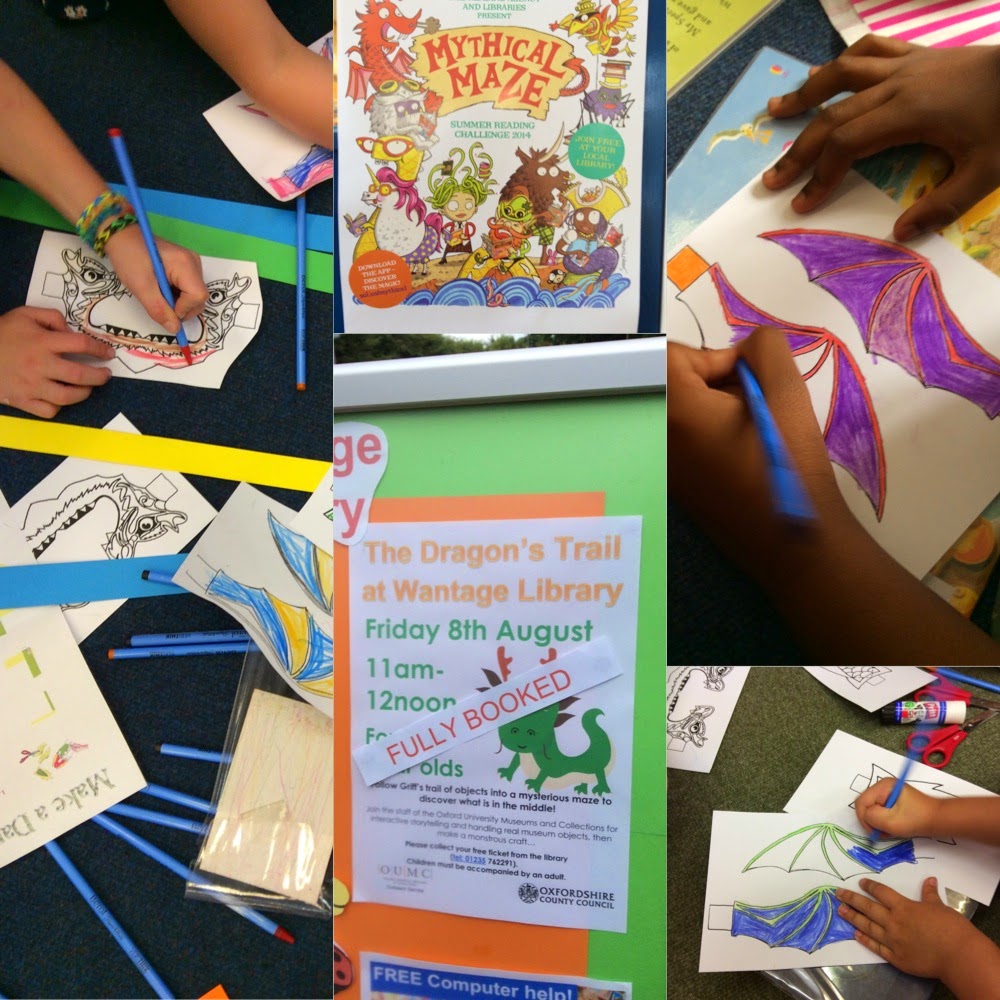
This summer, I spent two weeks going out to 12 different libraries around the county with museum objects. Our session included a story, handling  5 different museum objects and a craft activity. 

 
Planning the session for this series was one of the first projects I started when I arrived at the museums in June. It was a lot of responsibility, but also really exciting to be able to see a project through from beginning to end. I chose the objects, wrote the story to introduce them, decided on the objects and craft to go with it and prepared all the resources. The session is dragon-themed to link to the Summer Reading Challenge; a national scheme run by the Reading Agency, which challenges children aged 4 to 11 to read 6 books of their choice over the summer holidays.


I was nervous going out with Nicola (one of the Museums’ Community Outreach Officers) for the first session, especially as hearing someone else reading my story was quite strange.  By halfway through the first week, I’d seen Nicola and her colleagues Susan and Caroline all deliver essentially the same session but in very different ways. This was very interesting, but I was glad that I could watch Susan present several times and get a better idea of how I might run the session. 

In the second week, I was leading the sessions myself. I started by reading the story and having help with the handling session. By the end I was leading the whole session, and at the last one I ran it entirely by myself from beginning to end – Susan was hiding so I could find out how it felt to be there alone!
I enjoyed telling the story and really noticed myself improving and getting more confident each time I told it. Leading the object handling was a steeper learning curve, as the groups were often a very wide variety of ages, it turns out that 4 year olds and 8 year olds react to questions very differently!


It did seem a bit strange to go into a library representing a museum, as the groups were expecting stories and library activities. Bringing objects in was something a bit more unusual, and sometimes  offering object handling between the story and the craft meant that groups seemed to be looking forward to the craft more than engaging with the objects. In other places, the museum object-handling held the group’s attention and I felt that the audience connected with the museums as well as the activity.
The families enjoyed the sessions, especially as there was a mixture of listening and doing, so there was something for everyone. It also tied in well with the Summer Reading Challenge - some children even came to the session wearing their Summer Reading medals!


As for me, I really enjoyed getting to grips with one session in different places, though with 12 libraries in 8 days over 2 weeks, it was a bit of a whirlwind!

Tuesday, 26 August 2014

From Volunteer to trainee: A similar event one year later - Corie Edwards


It was about mid-way through last year when I signed up as a Family Friendly volunteer with the Oxford University Museums and Collections (OUMC) Volunteer Service. There were many reasons for this decision, but by far my main motive was staying involved in education. I had only been in this city for a few months when I signed up and therefore once it was time to actually sign my name to an event I was excited and nervous. Excited because I had the chance to be involved in something I enjoy doing and nervous because I didn’t know anyone and knew very little about the museums and collections at that time. As it was summertime, the first event I decided to take part in was a Fruit and Veg picnic at the Oxford Botanic Garden.


I arrived early at the Garden so that the education team could run through everything the volunteers would be doing that day.  Throughout the three-hour event I was busy helping families, and at the end we did a bit of a cleanup. This is very much a usual day when volunteering at family events. I thoroughly enjoyed my time and continued volunteering through the OUMC volunteer service as often as I could.


Now, one year later, I am an HLF Skills for the Future Trainee and my first placement is with the Oxford Botanic Garden and Harcourt Arboretum. It seems fitting that my first placement is at the same place I had my first experience as a volunteer with the OUMC volunteer service. It really hit me this Saturday how far I have come in this last year because I worked the Fruit and Veg picnic at the garden this year, but as a member of staff. And needless to say working at the Fruit and Veg picnic this year as staff is very different to being a volunteer at it last year.

Fruit we used to sow seeds


Although the picnic had the same theme, there were different activities from last year to this year. This year we had basket making out of willow branches, sowing pips children collected from open fruits, and guess the smell pots, as well as various other things such as storytelling, live music, and face painting. As a trainee I was able to see far more of what goes into setting up and running these events than I did as a volunteer.


Visitors taking part in our activities

Just as a starting point, the planning for this event started even before my traineeship did as to have it advertised in the family friendly leaflet you need to have an idea of what you are going to do at least six months in advance. The days leading up to the family event are about creating resources and trying to get everything in order. On the day of the event the education officers and myself arrive about three hours before the start time to get everything together, set-up and out in the public area so that we can start right on time.


We had great weather for this picnic and a good turnout of families taking part. The two parts of this picnic that stuck out to me most were the basket making and storytelling.


It seemed to stick out to participants as well:


“We had a lovely afternoon listening to stories and making baskets! What a great idea. More of these please!”


The basket making was extremely popular and we actually went through all of the branches we had collected from the Arboretum. Families seemed to really enjoy how hands-on this craft was and the level of creativity. I saw many families get so involved in their basket they had no idea of the hours passing.


Basket making

A comment left by a teenage visitor:

“I think it has been an amazing experience doing this basket for 3 hours. Mostly because of the teamwork (or family work) and how with so many little things we can do a beautiful thing. Thank you :).”


The reason story telling sticks out in my mind is because this was my first time storytelling to a large group of families. I have read books to children previously, but never have I read to that many with their parents in one room. I was very nervous beforehand and even took the books with me on lunch break so I could read through them a couple times whilst eating! Once I was in front of the kids and started reading the nervousness passed, and by the end I felt quite delighted by little chuckles and wide eyes. 


Emma and Corie storytelling

You always hear it as a volunteer about how essential you are for the museum teams and events they run, but speaking for myself, I never actually realized how true that is. At the fruit and veg picnic I finally got it! The staff at the garden doesn’t usually do storytelling, they hire in a professional. However, our hired storyteller could not attend this picnic and therefore it was Emma and I who delivered. We could not have done that if we didn’t have three volunteers and another member of staff back at the activities. Having volunteers is essential and makes events better. Better for the staff to not have to be stretched in multiple directions and most importantly, better for those attending because they have multiple people to go to. 


One of our amazing volunteers

As a volunteer I enjoyed every event I helped with the OUMC volunteer service. It allowed me to better understand all the museums and collections, better understand the city I lived in, and make connections with people who enjoy similar things. I don’t think I would be where I am without this previous volunteer experience. I still truly enjoy family events and love that I have this opportunity to be a bigger part in their creation and dissemination.

Monday, 11 August 2014

Valiant Vikings Family Workshop - Mary Cook


What connects Vikings of the 10th Century and Victorians of 1840? If you came to the Ashmolean Museum for the Valiant Vikings event you will have a fighting chance of knowing the answer to that question. 


You will also know how to embarrass a Viking, why Vikings did not come to England by aeroplane; why so many of the silver brooches in the Cuerdale Hoard were chopped to pieces and why bones were not found at the site of the find.  You might even know why finders weren’t always keepers.


When I arrived at the Ashmolean Museum fresh from induction tours of the University Museums and buzzing with anticipation, I was given my very first placement task: create a trail on Vikings for famillies. I did not know the collection terribly well then, but what a fun thing to do – spend time touring the museum looking at fabulous objects. 


 Vikings then.  Here we go.   

Challenge one, find the objects.
 
The Ashmolean in that first week felt huge and slightly disorientating but I found a small collection of Viking items in Gallery 41, the England Gallery along with helpful display boards to give me some time and place context. I wrote down accession numbers and carried on down to the lower galleries where I found Rune Stones and Viking coins and a wonderful picture of Smaug from The Hobbit. 


Challenge two, find pictures of the objects. 
 
When the museum is about to launch a new exhibition is not the best time to be looking for images.  Some of the items I liked were on loan to us so could not be directly referenced, some were not yet in the image archive and some held copyright restrictions, picture library staff were run off their feet getting ready for the Discovering Tutankhamun  exhibition.   Necessity is the mother of invention and the rest of the team gave invaluable help in working around these restrictions.  


Challenge three, print the trail.
 
For some reason the photocopier elected to breakdown the day I needed to print out 100 copies of the trail.  Turns out there is another copier in Antiquities.  Not an antiquated one either, so that did the job.  

Viking trail

Challenge Four prepare the craft activity and plan the event. 
This was so much fun, I created a longboat craft,  and also found inspiration on the internet via Pinterest for Viking craft ideas.  One of these was using card, glue and tinfoil to create Viking Brooches.  My version differed by taking inspiration from the forms found in our collection – tortoise oval shape, animal head shape and circle.  Some children who came recognised the craft as being similar to Celtic or Anglo Saxon forms, which sparked conversation about how migration enables cultural transference – well, all right, not exactly in those terms!  

Brooch activity examples


When devising crafts, I like to think about the value to families beyond the event. It was great to watch a brother and sister sailing their longboats over choppy seas as they left the education studio too.  I also really like crafts which link to the narrative of the collection and the relevant objects we hold here.  The brooch was good, but I also wanted to introduce the concept of hack silver and add some differentiation for children who either prefer non messy crafts or whose families had less time to spend on the activity.  A colour and cut out at home brooch jigsaw fitted that purpose and drew attention to the fact that much of the Cuerdale hoard was hacksilver, cut up and broken down either to make new pieces or to share out as a war chest. I also had some white card template blanks for colouring just in case too, so that there could be differentiation but not exclusion from the activity – you could still add a pin and have a brooch.  At least one family found this helpful.  We were able to offer a range of choices for design and embellishment which children clearly valued. We had several comments from children from this event, showing that they felt able to give feedback and be heard. 

brooch jigsaw


The longboat craft was also a non messy craft, cut out and colour, but I chose to keep the design empty to allow for real freedom. I saw a granddad happily colouring along side the grandchildren, he had put a red skull on the black sail of his longboat and was having a chat with the children about his design and theirs. We had longboats and sails of all kinds of colours and I saw some parents added Vikings made from scrap card to add to the play value for their younger child. While two mums chatted, two boys were singing strange high pitched songs while waving longboats they had made, because Vikings sing that way apparently. The simplicity and lack of mess from this craft meant it could take place in the atrium which is visible from several floors in the museum and is at a main point of access.  This helped families become aware of the other opportunities to take part in our Vikings event.


One of the mums and a couple of grans made brooches of their own alongside the children. Some families did one activity, some did everything we offered.  


Challenge Five: Brief Volunteers and Deliver the Event 


The volunteer team consisted of both very experienced team members and those who were new on the day. Where possible it is helpful for experienced volunteers or staff to work alongside new volunteers.  It was good to observe some good mentoring between the volunteers and good examples of using initiative to ensure that we did not run out of items needed to continue the activities.  They also did not hesitate to ask for support or clarification where needed which I really appreciated. I especially liked that the team worked together so seamlessly to ensure families were welcomed, had everything they needed and were aware of all that was on offer.

One criticism (the only criticism) I received was that volunteers did not know all the details of the event, eg where the tour would be delivered or how long it would last.  This was something I could have done better, it was an oversight on my part and I think I need to create a briefing checklist for future events.  This will help me to ensure all the volunteers know what is being offered, where, when , by whom and for how long.  


As well as the crafts and trail we offered a Story Tour in the England Gallery.  This meant gathering people from both rooms. I had a toy sword which I held aloft and called out “Follow the sword for a Viking Story Tour!” People gathered and kept together using this technique, though it would be disruptive to use if other groups were touring in the space at the same time. The tour took us to the second floor so it was helpful for people to keep together and not feel forgotten.  The story was about the accidental discovery by workmen of the Cuerdale hoard, but I needed to create links between three time periods, now, the Vikings in 905 AD and 1840. I also needed to reference different locations beginning with Scandanavia and concluding with Lancashire. It was good to be in the Ashmolean for this – there are timelines and orientation maps of the world to use and a sword makes a handy pointer! 

Story tour


We reviewed what we had made by rowing our longboats from the World map in the East meets West Gallery to the England Gallery just as Vikings came by boat from Scandanavia.  We stopped by the timeline and talked about what a timeline is and how far back the Vikings were in time and when they came to England.  Children joined in, happy to put on a cloak, hold up a sword and an axe and find that without a brooch an heroic Viking would be embarrassed as his cloak would fall to the floor – lots of laughter at that! Then we moved forward on the timeline to Queen Victoria’s Wedding which was a few months before the Cuerdale find.  We moved around the gallery using story, song, questions and role play to really experience what it was like for the workmen of Preston hearing about the stories of treasure near where they lived (fireside story which moved us to the far side of the gallery). We had talked about working conditions for people at work in Preston and the levels of poverty there.  This made the find which appeared from behind the Large Rune Stone, much as it had appeared unexpected from the river bank very thrilling for the children who were crowding in to see it with great excitement.   They felt sad when I told how one of Lord Cuerdale’s staff declared it belonged to the landowner and was of no significance in any case being “tin buttons and bits of solder” to quote Joseph Kenyon’s account of June 1840. They really put themselves in the shoes of the workmen in the story. 


I concluded the tour with questions about why the Hoard was buried there, the children by this time told me they thought Vikings had buried it. One child told me he thought it was buried there as grave goods – we were able to talk about why usually archaeological finds are often from graves but this one was not. We talked about the location and its proximity to Dublin and the date being assessed by reference to the coins in the hoard. Children asked and answered lots of interesting questions.  They had shown empathy with both the Vikings and the Victorians in the story, but when I asked them whether these 8000 coins and 7 stone in silver was the finest treasure in all of England they were not sure.  We reviewed our “journey” and I left the families to admire the Alfred Jewel while thinking about what treasure is.   

Feedback
Comments cards showed the event had been appreciated, but the one to one conversations and questions following the story tour as well as seeing the engagement of the audience showed me what those cards did not tell.  I had worked with an audience who learnt something new, felt empathy for others, made sense of objects maps and timelines in the museum and were even shocked and surprised at different points in the tour, a great privilege for me and something I hope to see more and more as my heritage learning career progresses.